
Data Ownership
Clear accountability for every domain, owners, stewards, and decision rights defined and adopted across the business.

Design and implement governance frameworks, ownership, quality, lineage and compliance, that make your data AI-ready.
Data Governance is the foundation of every AI programme. We design and implement governance frameworks, data ownership, quality standards, lineage tracking, and compliance controls, that make your data AI-ready.
Powered by Owl Sight for continuous quality monitoring and anomaly detection. Data Governance is the entry point to AI, organisations that skip it fail.
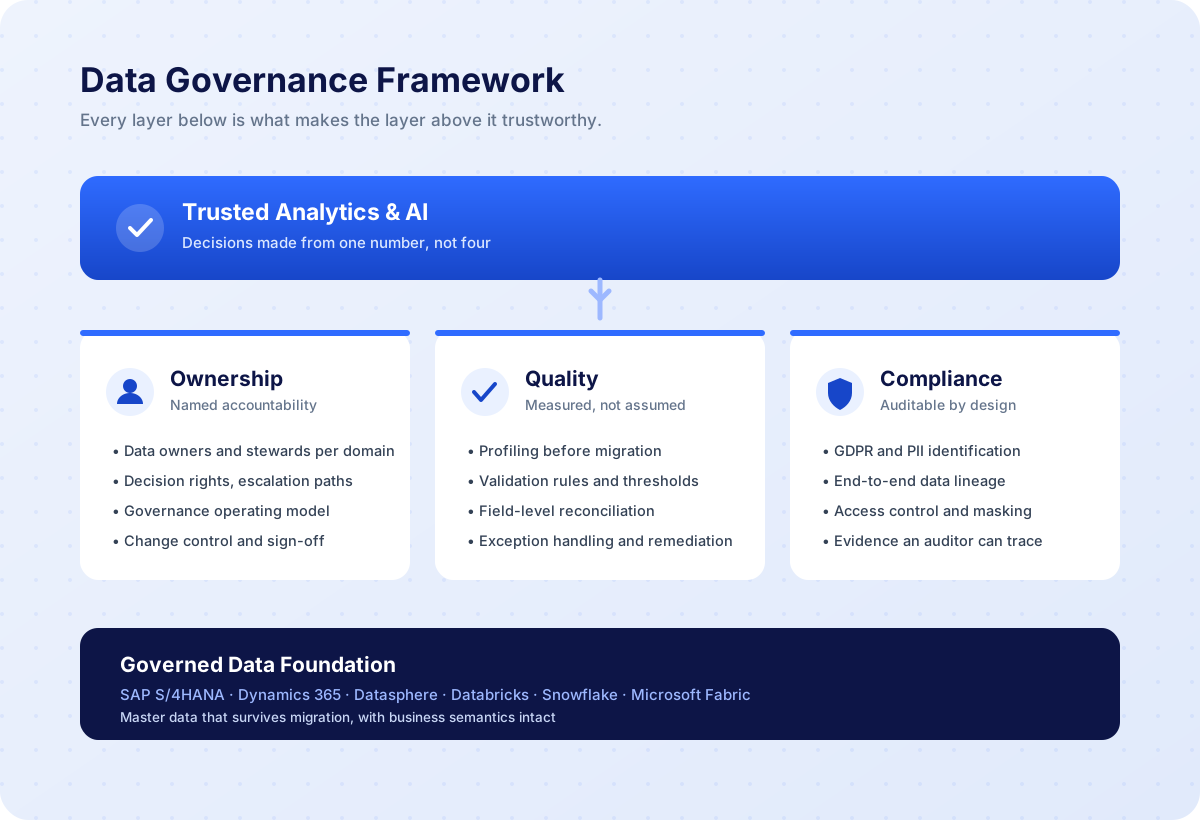
Clear accountability for every domain, owners, stewards, and decision rights defined and adopted across the business.
Measurable quality rules for accuracy, completeness and timeliness, enforced through automated controls.
End-to-end visibility of how data moves and transforms, from source system through every downstream AI model.
Policy-driven controls aligned to GDPR, industry regulation, and internal audit, built into the platform, not bolted on.
Bed manufacturer engagement, DAMA-based data strategy, 32 stakeholder interviews, blueprint phase. The programme delivered clear ownership, quality baselines, and a governance operating model the business could adopt.
The Nextgenlytics View
Every AI programme we deliver starts with governance, because organisations that skip it fail. We design the framework, embed the controls, and monitor quality continuously with Owl Sight.
Data governance is the framework that assigns ownership, quality standards, lineage tracking and compliance controls to an organisation's data. For every data domain it answers four questions: who owns it, how good it has to be, where it came from, and which regulations apply. It is an operating model that people follow, not a tool you install.
Because an AI model inherits the quality of the data underneath it, and without governance nobody can say whether a wrong output came from the model or from the record it read. That ambiguity is what stops most enterprise AI pilots from reaching production, which is why every AI programme we deliver starts here.
Four: data ownership, so every domain has named owners and decision rights; quality standards, expressed as measurable rules rather than aspirations; lineage tracking, so you can trace any figure back through every transformation to its source; and compliance controls aligned to GDPR and internal audit, built into the platform rather than bolted on afterwards.
DAMA-DMBOK is the Data Management Body of Knowledge, the industry-standard reference framework for data management disciplines. We use it as the structure for governance engagements because it gives clients a recognised, auditable framework rather than a consultancy's private methodology.
A blueprint phase — stakeholder interviews, current-state assessment and a prioritised control roadmap — typically takes six to ten weeks. Implementation then runs domain by domain rather than all at once, so the first governed domain delivers value within a few months instead of at the end of the programme.